Play Hitori Online
Shade cells to eliminate duplicate numbers in every row and column. Shaded cells can't touch, and all unshaded cells must stay connected. Pure logic — zero guesswork.
Created by Brian Hamilton
Tap a cell to shade it — tap again to confirm or clear
How to play Hitori
Shade squares until no number appears twice in any row or column among the squares you have left.
- No two shaded squares may touch edge to edge. Diagonal contact is fine.
- The squares you keep must all stay connected — you must be able to walk between any two of them without crossing a shaded square.
- A number that already appears only once in its row and once in its column can never be shaded.
- Every puzzle has exactly one solution and never needs a guess.
Controls: click a square to shade it, click again to mark it as definitely kept, and a third time to clear it. Check highlights mistakes.
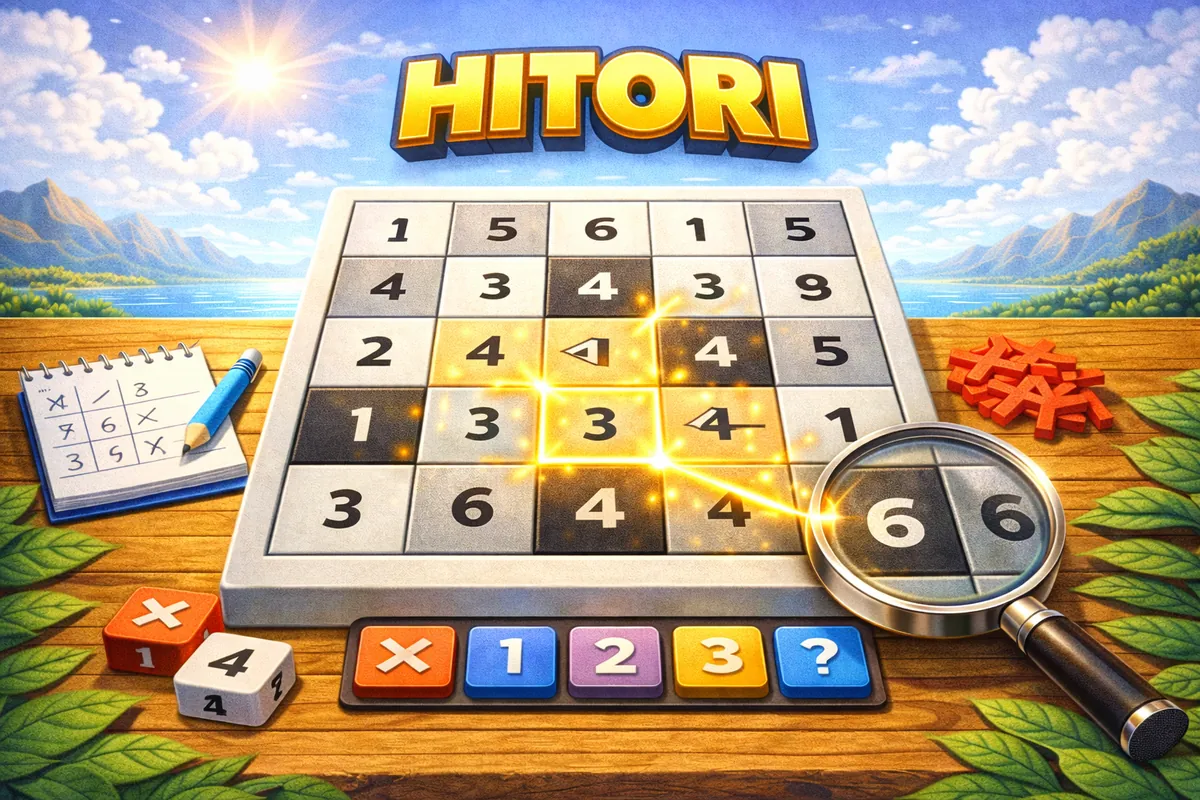
Half the grid is already settled
Hitori looks forbidding because the whole grid is numbers and none of them are marked. But a large part of any board is decided before you make a single deduction, and spotting it costs nothing.
A square can only ever be shaded to remove a duplicate. So if a number appears only once in its row and only once in its column, nothing can ever require it to go — it is unshaded, permanently, and you can mark it now.
| Difficulty | Squares free at the start | Share of the board |
|---|---|---|
| Easy | 32.7 of 64 | 51% |
| Medium | 26.1 of 64 | 41% |
| Hard | 20.3 of 64 | 32% |
That is the actual difference between the difficulty settings on this page. Hard boards are not built from trickier logic; they are built with more repeated numbers, which shrinks the free opening from about half the grid to about a third. Marking those squares first is not a warm-up, it is most of the scaffolding you will get.
The rule everyone teaches first does almost none of the work
Every Hitori tutorial opens with “no two shaded squares may touch”. It is a real rule and you must obey it, but as a tool for making progress it is close to useless.
Running the solver over 30 medium 8×8 puzzles and recording which rule produced each of the 1,146 deductions gives a clear ranking — and the touching rule comes last by a distance.
| Rule | Deductions | Share |
|---|---|---|
| Last one left of its value in a line → unshaded | 647 | 56% |
| Duplicate of a known unshaded square → shaded | 448 | 39% |
| Neighbour of a shaded square → unshaded | 51 | 4% |
The rule at the top is the one to internalise, and it is the one tutorials mention last if at all. Stated carefully: if every other square in a row holding a particular value has already been shaded, the one still standing must be unshaded — because a row cannot lose all copies of a value it contains. The same argument works down columns.
The second rule is the obvious one and it is worth 39%: once you know a square stays, every other square in its row or column with the same number must go.
Use the touching rule to check your work, not to drive it. It will rarely be the thing that unlocks a board.
You will never have to guess
Every puzzle here is run through a solver before it is offered, and only puzzles with exactly one solution are kept. More than that: applying the three rules above repeatedly, with no trial and error whatsoever, solved every board tested — 6×6, 8×8 and 10×10, easy through hard.
So if you are stuck, you are not missing a lucky guess. You are missing an application of the first rule somewhere — almost always a line where one value has quietly been reduced to a single surviving square.
A worked board
Take the grid above, with its 14 free squares already marked. From there the rules simply cascade: each unshaded square shades its duplicates, each shaded square frees its neighbours, and each line that runs out of alternatives fixes another square.
The connectivity rule is the one to check last rather than reason with. It is a genuine constraint — the unshaded squares must all touch each other edge to edge — but it rules things out far more often than it forces them. If you find yourself about to shade a square that would cut a corner of the grid off from the rest, that is when it earns its keep.
Where solvers get stuck
Hunting for pairs instead of scanning lines. Two identical numbers in a row tell you almost nothing on their own — either one could be the one that goes. The progress comes from lines where a value has been narrowed to one candidate, which you only see by scanning a whole row or column at once.
Marking only the shaded squares. Knowing a square stays is what triggers the 39% rule. If you are not marking confirmed-unshaded squares, you are throwing away the information that drives the solve.
Shading both of a pair. Tempting when two duplicates sit next to each other, but a row cannot lose every copy of a value — and if they are adjacent, the touching rule forbids it outright. One of them stays.
Two things you can check about these puzzles
The unshaded squares always form a Latin square in disguise. Each board starts life as a grid where every row and column already contains each value exactly once. The generator then picks squares to shade and replaces their values with duplicates drawn from the same row or column. That is why the answer is always consistent, and why the numbers you end up keeping never clash.
Difficulty is the number of duplicates, and you can count them. The generator shades roughly 18% of squares on Easy, 24% on Medium and 30% on Hard. Every shaded square is one extra duplicate on the board, which is exactly what shrinks the free opening from 51% to 32%. Count the numbers that appear twice in a row on an easy board and then on a hard one — the gap is the difficulty setting.
Hitori and its relatives
Hitori (ひとりにしてくれ) is Japanese for “leave me alone”, and it was first published by Nikoli, the magazine that popularised many of these puzzles. You will occasionally see it in English as Hitori ni shite kure.
It sits in the same family as other shading puzzles but its constraint is unusual. Where Nurikabe asks you to shade a connected sea around numbered islands, Hitori asks you to shade duplicates — the numbers themselves tell you what may go, and connectivity applies to the squares you keep rather than the ones you remove.
More logic puzzles
If you like puzzles where the numbers police themselves, try these: