Play Nonograms Online
Free nonogram puzzles (also called Picross, Griddlers, or Hanjie) — pick a grid size and start solving. No account needed.
Created by Brian Hamilton
How to play Nonograms
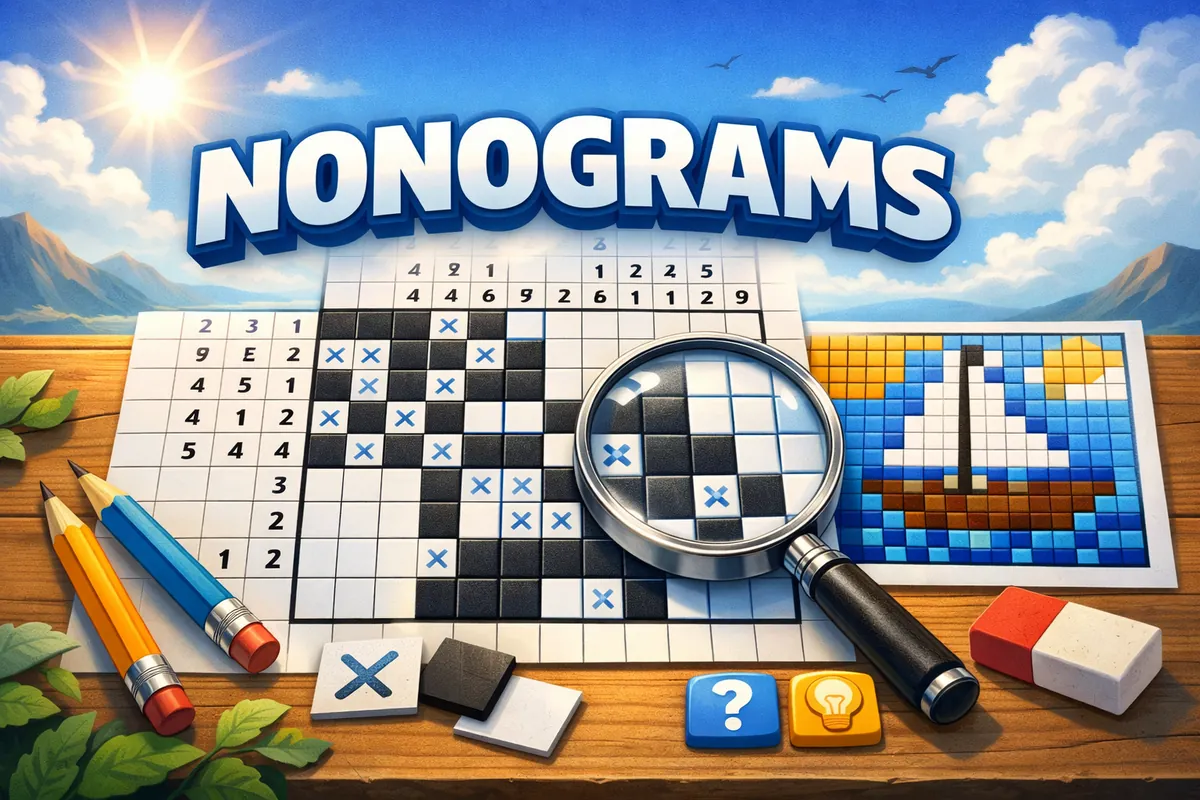
Fill in squares to reveal a hidden picture. The numbers beside each row and above each column tell you the lengths of the filled blocks in that line, in order.
- A clue of
4 2means a block of four filled squares, then at least one gap, then a block of two — in that order, left to right or top to bottom. - The clues say nothing about where the blocks sit, only their lengths and their order.
- A clue of
0means the line is entirely empty. - Every puzzle here can be solved one line at a time. You never need to guess.
Controls: use Fill to shade squares and Mark to cross off ones you have proved empty. Drag to do several at once. Check highlights mistakes.
You can always start, even on an empty grid
The blank grid is where most people stall. It looks as though you need a foothold before any reasoning can begin, so the temptation is to guess a plausible-looking cell and hope. You never have to. There is a technique that works on an untouched row before you know a single thing about the picture.
Take a row of ten squares with a single clue of eight. Slide that block of eight as far left as it will go, then as far right. Some squares end up filled in both positions — and since the truth must be one of the possible positions, those squares are filled, full stop.
This is usually called the overlap, and for a single clue there is an exact formula: a clue of k in a line of length n forces 2k − n squares whenever that number is positive. A clue of exactly half the line forces nothing; anything larger starts paying out immediately.
| Line length | Clue | Squares forced |
|---|---|---|
| 5 | 3 | 1 |
| 4 | 3 | |
| 5 | 5 | |
| 10 | 5 | 0 |
| 6 | 2 | |
| 7 | 4 | |
| 8 | 6 | |
| 9 | 8 | |
| 15 | 8 | 1 |
| 10 | 5 | |
| 12 | 9 | |
| 14 | 13 |
One rule that covers every line
Rows rarely have a single clue, and 2k − n does not extend to crowded lines directly. But there is a single rule that does, and it is worth learning instead of the first one, because the first one turns out to be a special case of it.
Start with slack. Lay every block out end to end with exactly one gap between them, push the whole arrangement hard against the left edge, and count the empty squares left over on the right. That number is the slack, and it is the same for every block in the line — it is how much the line as a whole can breathe.
Each block of length k forces k − slack squares (or none, if that is negative). Add it up across the blocks and you have the whole line’s yield.
The single-clue case falls straight out: one clue of k in a line of n has slack n − k, so it forces k − (n − k), which is 2k − n.
| Length | Clues | Slack | Per block | Predicted | Actual |
|---|---|---|---|---|---|
| 15 | 5 4 3 | 1 | 4 + 3 + 2 | 9 | 9 |
| 10 | 4 3 | 2 | 2 + 1 | 3 | 3 |
| 10 | 8 | 2 | 6 | 6 | 6 |
| 10 | 3 3 | 3 | 0 + 0 | 0 | 0 |
| 10 | 2 2 | 5 | 0 + 0 | 0 | 0 |
Two things follow, and both change how you scan a grid.
Slack is a property of the line, not of a clue. Clues of 5, 4 and 3 in a line of fifteen have one square of slack between them, and every one of those blocks pays out — nine of the fifteen squares, before you look at anything else. Meanwhile 3 and 3 in a line of ten has a bigger largest clue than 2 and 2 in a line of ten, and both give you exactly nothing.
A big clue on a slack line is worthless; a small clue on a tight line is not. The 3 in that fifteen-long row contributes two squares. A clue of 3 in a ten-long row with another 3 beside it contributes none. Same number, opposite value. So scan for lines whose clues nearly fill them, and ignore the impressive-looking numbers with room to spare.
A worked grid, one line at a time
Here is a 5×5, with the row clues down the left and the column clues across the top. Nothing about it is special — it is what the ideas above look like in practice.
Work the rows first, and work each one entirely on its own — no peeking at the columns. For each row, list the arrangements of its clues that fit, and fill in any square that comes out the same in every one of them.
| Row | Clue | Slack | Arrangements | Squares decided |
|---|---|---|---|---|
| 1 | 4 | 1 | 2 | 3 |
| 2 | 2 2 | 0 | 1 | 5 |
| 3 | 4 | 1 | 2 | 3 |
| 4 | 1 2 | 1 | 3 | 1 |
| 5 | 5 | 0 | 1 | 5 |
The two highlighted rows have zero slack. A single clue of 5 in a row of
five obviously fills it; less obviously, 2 2 in a row of five does too
— two blocks of two plus the compulsory gap is exactly five, so there is only one
way to lay it out and all five squares are settled, filled and empty alike.
Rows 1 and 4 are the interesting pair. Both have slack 1, and they yield three squares and one. That is the rule doing exactly what it says: row 1 is a single block of 4, giving 4 − 1 = 3, while row 4 is blocks of 1 and 2, giving 1 − 1 and 2 − 1 — nothing from the first, one square from the second. Equal slack, unequal payout, and you can predict which is which before you write anything down.
Now the columns, and this is where the row pass pays off. Column 1 reads
1 2. Slack 1, so on a blank grid it has three possible arrangements and
forces a single square. But the rows have already established that its second and fifth
squares are filled — and those two facts alone cut three arrangements down to
one, resolving the entire column.
Every column behaves the same way. One pass across them and the picture is finished.
Notice what never happened: no two lines were considered together, and no square was tried to see whether it worked out. That is the whole method, and on this site it is guaranteed to be enough.
Where solvers get stuck
Marking only the filled squares. The empty ones carry just as much information. A square you have proved empty splits its line into shorter segments, and short segments are where overlap starts paying. Solvers who only fill in squares are throwing away half of every deduction they make.
Guessing when a line goes quiet. If a row yields nothing, that is not a signal to try something — it is a signal to go and work a column instead. Every puzzle here is solvable by working lines one at a time, so a line that gives nothing right now will give something once a crossing line has been advanced.
Re-reading a line you have already exhausted. A line only becomes informative again when one of the lines crossing it has changed. Work in sweeps — all rows, then all columns — rather than staring at one row hoping it will confess.
Two things you can check about these puzzles
You never need to guess — and that is enforced, not hoped for. Every candidate picture is run through a solver that works exactly the way the advice above describes: take one line, list every arrangement of its clues that fits what is already known, and fill in any square that comes out the same in all of them. Repeat across rows and columns until nothing changes. If that process fails to complete the grid, the picture is thrown away and a new one is drawn. Puzzles requiring a leap of faith never reach you.
Bigger grids are rejected far more often. That filter is much harsher than it sounds. Roughly 89% of random 5×5 pictures survive it, about 71% of 10×10s, but only around 29% of 15×15s — so on the largest size the generator is discarding about seven pictures in ten before it finds one you can actually reason your way through. It will try up to 500 times.
Nonograms, Picross, Griddlers and Hanjie
All four names describe the same puzzle. Nonogram is the common English term; Hanjie and Griddlers appear in British and international puzzle magazines; Picross comes from the Nintendo series that introduced the genre to a large audience. You will also see Paint by Numbers, Crucipixel and Edel.
The puzzle is generally credited to two Japanese designers working independently in the late 1980s, Non Ishida and Tetsuya Nishio. It spread through Japanese magazines before reaching British newspapers around 1990, and the English name is usually said to have been coined in honour of Non Ishida.
Colour nonograms, where clues carry a colour and adjacent blocks of different colours need no gap between them, are a related but distinct puzzle and are not covered here.
More logic puzzles
If you like deducing a picture from numbers alone, try these: